What are MCTs and why is everyone talking about them?
A few years ago, a friend introduced me to MCT oil. At the time, I was sceptical. Not just because the claims sounded too good to be true (although they absolutely did), but also because I knew the kinds of online health influencers they followed, and I didn't trust a word of it. According to the internet, this particular oil could apparently:
- boost metabolism,
- suppress appetite,
- improve brain function,
- increase energy,
- and help with weight loss.
As a physiologist, that immediately triggered alarm bells. Biology is usually far more complicated than that. So I did what scientists tend to do when we become suspicious: I went looking for scientific evidence.
There were some interesting studies, mostly in animals or small human trials, but nowhere near the level of evidence you might expect considering how confidently MCT oil was being promoted online. At the time, the science felt incomplete, fragmented, and in many cases oversimplified.
So, I decided to do a small MSc project on MCTs. If I’m honest, part of the motivation was simply to prove my friend wrong.
That did not entirely go to plan.
The first experiments were actually quite interesting. Some of the medium-chain fatty acids appeared to influence appetite-regulating pathways in hypothalamic cells differently from the long-chain fats we would normally study. The effects were subtle, mechanistically complex, and certainly not the “miracle fat” described online, but there was clearly something biologically interesting happening.
That was the moment I realised this topic deserved a closer look. Since then, MCTs have become an increasingly fascinating area of research for me, not because they are magic, but because they sit at the intersection of metabolism, appetite regulation, inflammation, and brain function. And perhaps more importantly, because they are a good example of how nutrition science often becomes oversimplified online.
This blog is the first in a short series exploring the science behind MCTs:
- what they are,
- how they behave in the body,
- what the evidence actually says,
- and why the story is much more nuanced than most headlines suggest
So, what actually are MCTs?
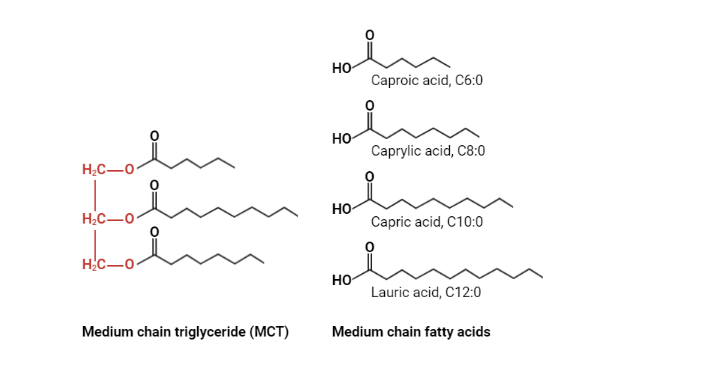
MCT stands for medium-chain triglycerides. These are fats made up of medium-length fatty acids attached to a glycerol backbone. They occur naturally in foods such as:
- coconut oil,
- palm kernel oil,
- butter,
- dairy products,
- yoghurt,
- and cheese.
The “medium-chain” part refers to the length of the fatty acids. Fatty acids are essentially chains of carbon atoms, and their length changes how they behave biologically.Medium-chain fatty acids usually contain between 6 and 12 carbon atoms. These include:
- Caproic acid (C6)
- Caprylic acid (C8)
- Capric acid (C10)
- Lauric acid (C12)
This distinction matters because people often talk about “MCTs” as though they are a single substance. They are not. Different medium-chain fatty acids may behave very differently in the body, and this is something that is often overlooked in commercial discussions around MCT oil.
Why are MCTs different from other fats?
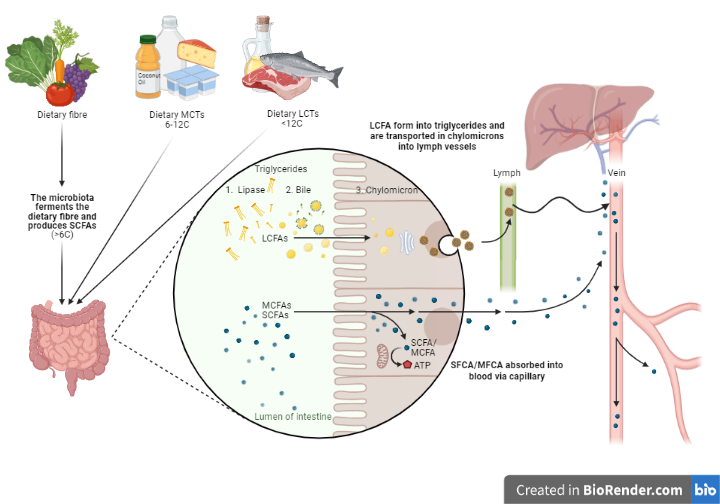
Most of the fat we eat consists of long-chain fatty acids. These require a relatively complicated digestive process involving bile acids, pancreatic enzymes, and transport particles called chylomicrons before they eventually enter the bloodstream. MCTs behave differently. Because they are shorter, they are absorbed more rapidly and transported directly to the liver through the portal circulation. There, they are more readily oxidised for energy or converted into ketones. This rapid processing is one of the reasons MCT oil became popular in ketogenic diets and fitness communities. The theory is simple:
- faster absorption,
- quicker energy availability,
- and potentially less storage as body fat.
At least in theory.
The important scientific question
What fascinates me most about MCTs is not whether they are simply “healthy” or “unhealthy,” but why different studies often report different outcomes. Some studies suggest MCTs may increase energy expenditure, alter appetite hormones, improve metabolic flexibility, or influence brain energy metabolism. Others show only modest effects, or sometimes no meaningful effect at all.
Part of the challenge is that nutrition science is incredibly difficult to interpret. Studies differ in:
- the type of MCT used,
- the dose,
- duration,
- participant characteristics,
- background diet,
- and whether researchers are studying short-term or long-term effects.
Even more importantly, many studies still treat all MCTs as though they behave identically, which they almost certainly do not. That, to me, is where the really interesting physiology begins.
Final thoughts
I started researching MCTs because I was sceptical.
Ironically, that scepticism is probably what kept me interested.
The more we studied these fatty acids, the clearer it becomes that the real story is not about miracle supplements or internet trends. It is about understanding how metabolism, appetite signalling, inflammation, and brain physiology interact in ways that are often far more complex than simple headlines suggest.